How to Monetize a Mobile App: Proven Strategies for App Growth in 2026
The App Graveyard Is Real — Here's How to Escape It
There are millions of apps sitting in the App Store and Google Play right now. Most of them make somewhere between $0 and "enough to buy a coffee." A fraction — a relatively tiny fraction — generate real, sustainable revenue.
The scary part? Most of those struggling apps aren't bad apps. They just have no monetization strategy. Or worse, they picked the wrong one and quietly drove their users away.
That's what this guide is here to fix.
Whether you haven't launched yet or you're sitting on an app with 50,000 users and roughly $0 in monthly revenue, this post covers everything you need: every proven monetization model, how to choose the right one for your specific app, the mistakes that silently kill revenue, and how to actually set all of this up in 2026.
We'll also cover the stuff most posts skip — pricing psychology, analytics, hybrid models, and how platform policy changes (Apple, Google) and privacy rules (ATT, GDPR) affect your options today.
Let's get into it.
Understanding the Mobile App Monetization Landscape in 2026
Why Monetization Strategy Must Come Before Development
Here's something a lot of developers learn the hard way: your monetization model isn't just a business decision. It's a product decision. It affects your UX, your tech stack, and even your database design from day one.
Apps that try to bolt on a monetization strategy after launch often end up with clunky paywalls that feel out of place, confused users who don't understand why things suddenly cost money, and retention numbers that fall off a cliff.
Think of it as "monetization-product fit." Just like product-market fit, the goal is for your revenue model to feel completely natural inside your app — not like an annoying interruption.
Before you pick a model, answer these three questions honestly:
- Who are my users? Casual consumers? Professionals? Gamers?
- What problem am I solving? A daily-use problem or a one-time need?
- How often will users return? Every day? Once a week? Once a year?
The State of Mobile App Revenue in 2026
A few things have shifted meaningfully in the last couple of years that every app developer needs to know:
- In-app purchases and subscriptions still dominate total consumer spend across both major app stores. If you want serious revenue, these two models are where the action is.
- The advertising world after ATT has matured. Apple's App Tracking Transparency framework changed how ad targeting works on iOS. The chaos of 2021–2022 has settled, but contextual and first-party data targeting is now more important than ever for ad-supported apps.
- AI-powered personalization is increasingly being used to serve the right monetization prompt to the right user at the right moment — rather than blasting everyone with the same paywall.
- Hybrid monetization is the norm for top-grossing apps. Most successful apps in 2026 combine two or three revenue streams rather than relying on just one.
- Platform policy is still evolving. Alternative payment options, updated developer agreements, and regulatory pressure (especially in the EU) mean the rules around billing keep changing. Stay current with Apple's guidelines and Google's equivalent.
The 8 Core Mobile App Monetization Models (Explained and Compared)
Let's walk through every major model. Don't worry — we'll help you figure out which one(s) actually fit your app later. For now, think of this as your menu.
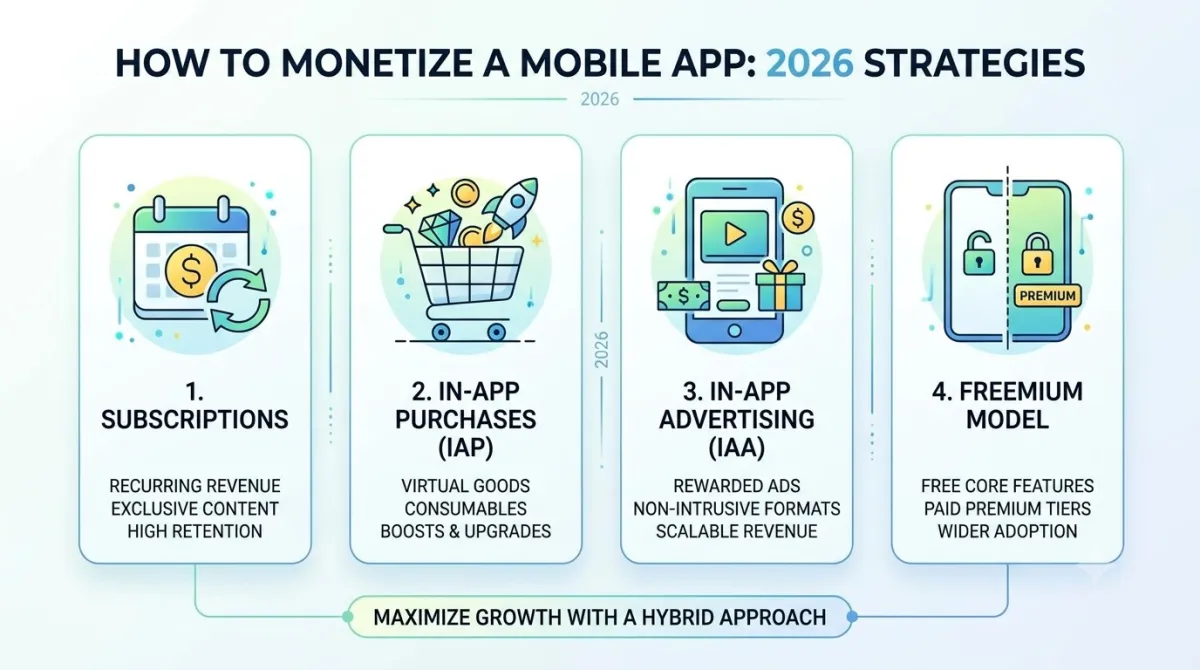
1. Freemium Model
How Freemium Works
The app is free to download. Users get a real, working set of features at no cost. Advanced features — the good stuff — require payment or an upgrade.
Why is this so popular? Because it removes the biggest barrier to acquisition: asking someone to pay before they've experienced any value. The conversion funnel looks like this:
Free download → Engaged user → Paying customer
There's a neat psychological principle at work here too. Once someone has invested time in your free app — customised their profile, completed a few tasks, built up a streak — they're much more likely to pay to keep going. Sunk cost and the endowment effect working in your favour.
When to Use Freemium
- Best for productivity apps, tools, utilities, and B2B apps with a mobile component
- Works well when the free tier has genuine standalone value — not a crippled demo
- Avoid it when your app's core value can't be meaningfully split into free and paid tiers
Freemium Optimization Tips
- Find your "aha moment" — the feature or result that makes users go "oh, this is actually great" — and put the next level just beyond it
- Use behavioural analytics to see where free users disengage and make that the upgrade prompt
- A/B test paywall placement and copy regularly — small changes can produce big conversion lifts
- Try a soft paywall (show the feature, then prompt upgrade) before committing to a hard one (block access entirely)
2. Subscription Model (In-App Subscriptions)
Why Subscriptions Are the Gold Standard in 2026
Subscriptions are the darling of the app economy right now, and for good reason. They generate predictable recurring revenue — the kind that investors love and founders sleep better with. When you know roughly what your revenue will be next month, you can plan actual growth.
Both Apple and Google tend to give subscription apps preferential placement in editorial features. And here's a quiet advantage most people don't talk about: subscribers churn less than one-time buyers when they've had a solid onboarding experience. You're building a relationship, not a transaction.
Structuring Your Subscription Tiers
- Monthly vs. annual: Annual plans dramatically reduce churn. A "2 months free" discount is a proven way to push users toward annual.
- Common tier structures: Basic / Pro / Team, or Lite / Standard / Premium
- Price anchoring: Always show your highest-priced tier first. It makes the middle tier feel like the sensible, rational choice.
- Free trial length: 7 days for apps with a fast "wow moment"; 14–30 days for complex tools that take time to show ROI
Reducing Subscription Churn
There are two types of churn and they need different fixes:
- Involuntary churn (failed payments): Use retry logic and in-app prompts to recover these. Tools like RevenueCat handle this automatically.
- Voluntary churn (cancellations): Give users a pause option, a downgrade path, or a simple "why are you leaving?" survey. You'll learn a lot and recover some cancellations in the process.
3. In-App Purchases (IAP)
Types of In-App Purchases
- Consumables: Virtual currency, lives, power-ups — spent and gone, so users buy again (high LTV potential)
- Non-consumables: One-time unlocks like removing ads, extra levels, premium filters
- Subscriptions: Covered in the section above
Note: Platform policies dictate how IAPs are implemented. For web-based or hybrid apps, see our breakdown of Apple Guideline 3.1.1 and when In-App Purchase is enforced.
Designing an Effective IAP Economy
The virtual economy principle: give users a free drip of currency or resources, then sell ways to accelerate. Think of it like a game within a game.
- Pricing ladder: Offer a range from $0.99 to $99.99. This captures casual spenders and high-value "whale" users — a small group who drive a disproportionately large share of IAP revenue.
- Loss aversion triggers: Limited-time offers, bundle deals, and "starter packs" consistently accelerate conversions.
- For non-gaming apps: IAP works for premium stickers in messaging apps, advanced filters in photo apps, extra cloud storage in utility apps. Frame it as "unlocking value," not "removing limitations." That framing shift alone can lift conversion.
4. In-App Advertising (Ad Monetization)
Types of In-App Ad Formats
| Format | CPM Level | User Experience Impact | Best Use Case |
|---|---|---|---|
| Banner Ads | Low | Low (but clutters UI) | Use sparingly or avoid in premium contexts |
| Interstitial Ads | Medium–High | High risk if overused | Natural transition points only (between levels, after task completion) |
| Rewarded Video | High | Positive (user opts in) | Games, apps with in-app currency |
| Native Ads | Medium | Low if well integrated | Content-heavy apps |
| Playable Ads | High | Engaging | Primarily games (as ad units served to other apps) |
Choosing an Ad Network in 2026
- Major networks to evaluate: Google AdMob, Meta Audience Network, Unity Ads (merged with ironSource), AppLovin
- Mediation platforms like MAX by AppLovin or Google AdMob Mediation let you run multiple networks simultaneously — this increases fill rate and eCPM meaningfully. Using a single network leaves real money on the table.
- Post-ATT: Contextual targeting and first-party data have become more valuable than behavioural targeting on iOS
Maximizing Ad Revenue Without Destroying UX
- The "natural break" rule: only show ads when the user is naturally pausing, never mid-task
- Rewarded ads are a consent-based alternative to paywalls — let users choose between watching an ad or paying. People respect that choice.
- Track eCPM, fill rate, and ARPDAU (Average Revenue Per Daily Active User) as your core ad KPIs
5. Paid App (One-Time Purchase)
The Case For and Against Paid Downloads
Users pay upfront to download. No free tier, no ongoing billing. Simple.
This model still works — but only in specific situations. It's best for niche professional tools, specialised utilities, and apps with a clear, obvious one-time value proposition. The challenge is that people can't try before they buy, which means discovery and conversion are much harder than in a freemium model.
Paid apps represent a shrinking share of overall app store revenue, but "shrinking" doesn't mean dead. For the right app, it's still a solid choice.
How to Price a Paid App
- Research what competitors charge in your category on both stores
- Psychological pricing: $0.99–$2.99 for consumer apps; $4.99–$9.99+ for professional or specialised tools
- "Buy once, use forever" is increasingly a differentiator as subscription fatigue grows among users
6. Sponsorships and Brand Partnerships
How App Sponsorships Work
A brand pays to have their product, logo, or offer featured in your app. You'll see this most in fitness apps partnering with nutrition brands, weather apps working with outdoor gear companies, or local discovery apps featuring regional businesses.
There are two common structures:
- Flat fee for exposure or placement in your app
- Revenue share based on conversions your app drives
This model works best when you have a clearly defined, engaged audience that a brand actually wants to reach. A niche community is more attractive to sponsors than a vague general audience.
Finding and Pitching Sponsors
- Build a media kit with DAU, MAU, session length, demographic breakdown, and engagement benchmarks
- Target brands whose product is adjacent to your app's core value — a running app pitching a hydration brand, not an accounting software company
- Start with performance-based deals (easier to close, builds proof) before going for flat-fee sponsorships
- LinkedIn direct outreach works well for indie developers without agency connections
7. Affiliate Marketing and Referral Revenue
Integrating Affiliate Links in Your App
If your app recommends products, services, or tools, you can earn commissions through affiliate programs. Think recipe apps linking to grocery delivery, book apps linking to purchases, or travel apps linking to hotel bookings.
- Well-known programs: Amazon Associates, ShareASale, CJ Affiliate, and direct brand affiliate programs
- Disclosure is mandatory: FTC rules (and equivalent regulations globally) require you to clearly disclose that links are affiliate-based. Don't skip this.
- Affiliate links only work when they feel like a natural recommendation, not a forced ad. Integration matters as much as the link itself.
Building a Referral Loop for User Acquisition + Revenue
- Two-sided referral programs work best: reward both the person who refers and the new user (e.g., both get a free month of premium)
- Referred users typically have higher LTV and lower churn than paid-acquisition users
- Tools: Branch.io, Appsflyer referral features, Adjust
8. Data Monetization and B2B Licensing
Selling Aggregated, Anonymized Data
Some apps generate genuinely valuable aggregate data that researchers, brands, or enterprise clients will pay for. Examples: mobility data from mapping apps sold to urban planners, or aggregated shopping behaviour from retail apps sold to market research firms.
B2B Licensing and White-Labeling
- White-label model: You build once, sell the same product to multiple businesses under their branding
- API monetization: Expose your app's core capability as an API that other businesses integrate into their own products
- Best suited for apps with unique technical capabilities, proprietary datasets, or highly specialised vertical solutions
How to Choose the Right Monetization Model for Your App
Too many options? Here's a comparison table to help you cut through the noise:
| Model | Best For | Revenue Type | UX Impact | Revenue Ceiling | Complexity |
|---|---|---|---|---|---|
| Freemium | Productivity, tools, B2B | One-time / Recurring | Low (if done right) | High | Medium |
| Subscription | High-engagement, retained users | Recurring (MRR/ARR) | Low | Very High | Medium–High |
| In-App Purchases | Games, content apps | Variable (consumable) | Medium | Very High | Medium–High |
| In-App Ads | High-volume free apps | Variable (CPM-based) | Medium–High | High (at scale) | Low–Medium |
| Paid Download | Niche professional tools | One-time | None | Medium | Low |
| Sponsorships | Niche, engaged communities | Flat fee / Revenue share | Low (if native) | Medium | Medium |
| Affiliate | Content, travel, lifestyle apps | Commission-based | Low (if natural) | Medium | Low |
| Data / Licensing | Specialised, data-rich apps | B2B contracts | None (backend) | High | Very High |
The Monetization-Product Fit Framework
Still not sure which model fits? Walk through these five steps:
- Define your user's relationship with the app — daily habit, occasional utility, or one-time tool?
- Identify where and when value is delivered — this tells you when to ask for payment
- Assess willingness to pay based on category benchmarks and competitor research
- Map your monetization model to your growth model — ads need volume; subscriptions need retention
- Validate with a minimum viable monetization test before fully committing to any model
Hybrid Monetization — Combining Models Strategically
Hybrid monetization isn't complicated. It just means layering complementary revenue streams so that each one adds value rather than stacking costs on the same user.
Combinations that work well:
- Freemium + Subscription + Rewarded Ads (common in consumer and gaming apps)
- Subscription + Affiliate (common in content and productivity apps)
- Paid + IAP for content expansion (premium games)
Combinations that hurt UX (avoid these):
- Subscription + Interstitial Ads shown to paying subscribers — a well-documented trust destroyer
- Freemium with both aggressive ads AND an aggressive paywall hitting users at the same time
Implementation: How to Set Up Monetization in Your App
Setting Up In-App Purchases and Subscriptions
- iOS (App Store): Use StoreKit 2 — Apple's current IAP and subscription framework. Key features include transaction history, offer codes, and subscription groups.
- Android (Google Play): Use the Play Billing Library — check current version requirements and compliance deadlines, which Google enforces strictly.
- Alternative billing: Regulatory changes in the EU and certain markets have opened limited alternative payment options. This is evolving fast — monitor developer policy regularly.
- Sandbox testing: Both platforms have sandbox environments for testing IAP before launch. Use them. Common pitfalls include testing with a real payment account and getting charged for your own product.
Integrating an Ad Network
- Select your network(s) — start with Google AdMob as a baseline (see our step-by-step AdMob integration guide)
- Integrate the SDK into your app — here's the full walkthrough for WebView apps
- Configure ad placements (follow the "natural break" rule from earlier)
- Test thoroughly in a development environment
- Set floor prices — minimum eCPM below which you won't show an ad
- Go live and monitor eCPM, fill rate, and impact on retention
Set up mediation from day one if you plan to use ads seriously. In-app bidding (where networks compete in real time for each impression) is now preferable to the traditional waterfall approach.
Subscription Infrastructure Beyond the App Stores
- RevenueCat: The most widely used third-party subscription management SDK for mobile. Handles entitlement management, analytics, and cross-platform support. Highly recommended for most teams.
- Paddle / Stripe: Relevant when your app has a web component where you're not forced to use app store billing — see our guide on payment gateways in WebView apps for what actually works technically inside a wrapped app
- Webhooks and entitlement management: Ensure users get access to what they paid for instantly and keep it for exactly the right duration
- Analytics integrations: Connect subscription data to Amplitude, Mixpanel, or similar for cohort analysis and LTV modelling
Pricing Strategy for App Monetization
Psychological Pricing Principles for Apps
How to Price Your Subscription or IAP
- Research first: Look at the top 10 competitors in your category on both stores. What are their price points, tier structures, and trial lengths?
- Van Westendorp Price Sensitivity Meter: A research framework that helps you find the price range your actual users consider acceptable, expected, and prohibitive. Worth running with even 50 survey respondents.
- Test price points: Both major platforms support price experiment tools. Use them before locking in a launch price.
- Regional pricing: App stores support localized pricing. Use it. A $9.99 USD subscription priced at equivalent local purchasing power converts meaningfully better in markets like Brazil, India, and Eastern Europe.
Free Trial Strategy
- Short trials (3–7 days): Best for apps where users see value quickly — meditation apps, simple tools, games
- Longer trials (14–30 days): Better for complex tools where ROI takes time to become obvious — project management, analytics, professional tools
- Opt-in trials (no card required): More trial starts, lower conversion rate
- Opt-out trials (card required upfront): Fewer starts, higher conversion rate — choose based on your acquisition cost economics
- Maximise trial-to-paid conversion with an onboarding sequence, feature discovery nudges, and end-of-trial urgency messaging
App Monetization Analytics — Measuring What Matters
Core Monetization KPIs to Track
| KPI | What It Tells You | Formula |
|---|---|---|
| ARPU | Baseline health metric for your overall monetization | Total Revenue ÷ Total Users |
| ARPPU | How much your paying users are actually worth | Total Revenue ÷ Paying Users |
| LTV | Predicted total revenue per user over their lifetime in the app | ARPPU × Average User Lifespan |
| Conversion Rate | How well you're turning free users into paying ones | Paying Users ÷ Total Users |
| Churn Rate | How fast you're losing subscribers | Cancelled Users ÷ Total Subscribers (per period) |
| MRR / ARR | The north star for subscription businesses | Sum of all active monthly / annual subscription revenue |
| eCPM | Ad revenue efficiency | (Ad Revenue ÷ Impressions) × 1,000 |
Cohort Analysis for Monetization Optimization
Aggregate metrics can lie to you. Cohort analysis tells you the truth.
When you look at Day 1, Day 7, and Day 30 cohorts, you can see exactly when users are most likely to convert — and what triggers that conversion. That's the data you need to make product decisions that actually move the needle.
- Identify the actions that correlate with conversion and design product experiences that push users toward them
- Different acquisition channels often produce users with wildly different LTV — cohort analysis reveals this
- Tools: Amplitude, Mixpanel, RevenueCat Analytics, Firebase
Attribution and Understanding Where Revenue Comes From
- Mobile Measurement Partners (MMPs): Appsflyer, Adjust, and Branch connect your ad spend to in-app revenue, so you know which campaigns generate paying users — not just downloads
- Post-ATT attribution: SKAdNetwork (iOS) has real limitations. Probabilistic attribution fills some gaps, but you'll need to get comfortable with less precise data on iOS than before.
- Organic vs. paid revenue split: Know what portion of your revenue is self-sustaining vs. dependent on ongoing ad spend. This is critical for understanding unit economics.
10 Mobile App Monetization Mistakes That Kill Revenue (and Users)
Mistake 1 — Choosing a Monetization Model After Launch
Retrofitting monetization breaks UX flows, alienates early adopters, and often requires expensive redevelopment. Define your revenue model during product design, not as an afterthought.
Mistake 2 — Showing Ads to Paying Subscribers
This is one of the most well-documented trust destroyers in the app economy. If someone is paying you, they expect an ad-free experience as a baseline. Gate ads entirely behind the free tier — ads are the "cost" of the free experience, not an extra tax on people who already paid.
Mistake 3 — Setting and Forgetting Pricing
Markets shift, competitors change, user expectations evolve. Static pricing loses revenue over time. Build quarterly pricing reviews into your product calendar.
Mistake 4 — Ignoring Churn Until It's a Crisis
Churn compounds quietly. A 5% monthly churn rate means you're replacing your entire subscriber base roughly every 20 months. Proactive retention — good onboarding, engagement nudges, smart cancellation flows — prevents the hole before you're desperately trying to fill it.
Mistake 5 — Over-Monetizing Too Early
Pushing hard monetization before you've confirmed product-market fit accelerates churn and generates negative reviews. Bad reviews from aggressive early-stage monetization are very hard to recover from — they stick to your ASO ranking for months.
Mistake 6 — Not Complying With Privacy Regulations
GDPR, CCPA, ATT, and App Store data policies all have direct monetization implications — especially for ad-supported apps. Non-compliance risks app removal, regulatory fines, and reputational damage. Engage a privacy consultant or legal counsel before monetizing with ads or data.
Mistake 7 — Using Only One Revenue Stream
Single-stream dependence creates existential risk. A policy change, algorithm shift, or platform update can wipe your revenue overnight. The most resilient apps have 2–3 complementary streams.
Mistake 8 — Misreading Free Users as Non-Valuable
Free users generate word-of-mouth, app store reviews, and social proof. They also convert to paying users when nurtured properly. Don't neglect their experience — it directly feeds your revenue funnel.
Mistake 9 — Skipping A/B Testing on Pricing and Paywalls
Gut-feeling pricing decisions leave real money on the table. Even small changes to paywall copy or design can produce double-digit conversion rate improvements. Test everything.
Mistake 10 — Not Accounting for App Store Commission
Apple and Google take 15–30% of all in-app revenue depending on your revenue tier and subscription duration. Factor this into your unit economics and pricing from day one. A $9.99/month subscription nets you roughly $7–$8.50 in practice — model your actual take-home revenue, not the gross.
Expert-Level Monetization Tips for 2026
Build Your Monetization Roadmap, Not Just a Model
Treat monetization like a product feature — it has a roadmap, experiments, releases, and retrospectives.
📍 Phase 2 (1K–10K users): Launch minimum viable monetization. Collect real data.
📍 Phase 3 (10K+ users): Optimize based on cohort data. Introduce hybrid revenue streams.
Schedule monetization retrospectives quarterly — review KPIs, pricing, and model fit against your current user data.
Leverage Push Notifications and In-App Messaging as Monetization Tools
- Send monetization prompts at moments of peak engagement, not arbitrary times
- Examples of effective triggers: "You've used [feature] 10 times this week — unlock unlimited access" or an end-of-trial countdown
- Respect notification fatigue: fewer, more relevant messages outperform high-frequency blasts every time
- Tools: Braze, Iterable, OneSignal, CleverTap
Optimize Your App Store Listing for Monetization (ASO)
A higher-converting store listing means lower effective CAC, which directly improves your LTV-to-CAC ratio. That's free money on the table. If you haven't built an install base yet, monetization is premature — work through how to get your first 1,000 app downloads first, then come back to this section.
- Your screenshots and preview videos should prominently show premium features — sell the aspiration, not just the free experience
- Keyword and metadata optimization drives organic discovery, which reduces your blended acquisition cost
Use Paywall Psychology Intentionally
- The best paywalls tell a story: "What can I do with premium that I can't do right now?"
- Social proof on paywalls — "Join 500,000 premium members" — reduces friction
- Risk reversal: "Cancel anytime" and money-back guarantee messaging materially increases subscription conversion
- Study paywall designs from top apps in your category using tools like Mobbin for inspiration
Plan for Web-to-App and App-to-Web Revenue Flows
Platform billing fees can be avoided on web purchases. Many apps now sell subscriptions via their own website (using Stripe or Paddle) and then grant access in-app — keeping the full revenue rather than giving 15–30% to the platform.
This is a nuanced, evolving area. Apple's policies on external purchase links have been changing following regulatory pressure in various markets. Stay current before implementing this approach.
Build an Email List From Your App Users
Email is a monetization-independent channel you actually own. Unlike push notifications, it doesn't depend on platform permission or algorithm changes.
- Use in-app prompts with a genuine value incentive to collect emails
- Email sequences for upsell, re-engagement, and win-back campaigns complement in-app monetization at a fraction of the cost of paid re-acquisition
How Real Apps Monetize Successfully (Documented Examples)
Duolingo — The Freemium + Subscription + Ads Hybrid
Duolingo's monetization model is extensively documented in their S-1 filing and subsequent earnings reports. The structure: a free tier supported by ads, with Duolingo Super (their subscription tier) removing ads and unlocking premium features.
What's particularly interesting — and publicly documented — is that Duolingo shifted focus from maximising the number of free users to optimising the quality of the free experience to increase trial intent. In other words, a better free product led to more subscription conversions, not fewer.
Lesson: Rewarded ads, when integrated thoughtfully into the free experience, can generate meaningful revenue without alienating users who genuinely can't afford a subscription.
Calm — Subscription-First with Strategic Partnerships
Calm's consumer subscription model is well-documented, as is their B2B partnership with American Airlines (offering Calm access to passengers in-flight). This is a textbook example of layering a B2B licensing deal on top of a strong direct-to-consumer subscription business.
Lesson: A strong consumer subscription creates leverage for enterprise and partnership deals — without changing the core product at all.
Monument Valley — Premium Paid + IAP Expansion Packs
ustwo games launched Monument Valley as a paid app and later released expansion chapters as separate IAPs. The team publicly addressed the backlash when they launched a paid expansion — some users felt content they expected to be free was being charged for — which became an important public case study in managing user expectations around IAP.
Lesson: Paid apps can successfully use IAP for content expansion, but clear upfront communication about what's included and what costs extra is non-negotiable.
Spotify — Freemium at Scale
Spotify's freemium economics are documented in detail across their public filings. The free tier is ad-supported; premium conversion is driven by deliberate friction — listening limitations and ad frequency that are calibrated to motivate upgrade without being so irritating that users leave for competitors.
Lesson: Freemium friction must be carefully calibrated. Too little and nobody upgrades; too much and you drive users to alternatives. Spotify has made this balance a core part of their product strategy.
Frequently Asked Questions About Mobile App Monetization
What is the most profitable mobile app monetization model?
There's no single winner — it depends on your app category, user behaviour, and scale. Subscriptions tend to generate the highest LTV for apps with highly engaged, retained users. IAP in gaming can produce extraordinary revenue from a relatively small percentage of paying users. Ad monetization scales with volume — it needs a large active user base to generate meaningful revenue.
The more useful question: what does "profitable" mean for your specific unit economics? Define LTV vs. CAC first, then choose your model.
How many users do I need before I can start monetizing?
You can — and should — test willingness to pay with as few as 100–500 engaged users. The distinction is between testing willingness to pay (which you can do very early) and generating meaningful revenue (which requires scale). Don't wait for a large user base to discover that nobody will pay. Validate early, even informally through user interviews or beta pricing tests.
Can I use multiple monetization models at the same time?
Yes — hybrid monetization is the norm for top-grossing apps. The key rule: each additional layer should add user value or offer user choice, not stack costs on the same user. Free users seeing ads while paid subscribers don't is fair and accepted. Paid subscribers seeing ads on top of their subscription fee is not.
How does Apple's App Store commission affect my revenue?
Apple charges 30% on most in-app purchases and subscriptions. Developers in the Small Business Program (under $1M in annual earnings) pay 15%. After the first year of a continuous subscription, Apple's cut drops to 15% as well. Google Play has a similar structure.
In practice, a $9.99/month subscription nets you approximately $7–$8.50 depending on your tier and platform. Model your actual take-home revenue from the start, not the gross. This is also an evolving area due to regulatory pressure globally — monitor current developer policies.
What is the average conversion rate from free to paid in a freemium app?
Publicly cited benchmarks suggest 2–5% free-to-paid conversion is common for consumer apps, but top performers in specific categories achieve significantly higher. More importantly: don't benchmark yourself against averages without accounting for your category, price point, and user segment. The quality and LTV of converted users matters more than the raw conversion percentage.
How do I monetize an app without annoying users?
The core principle: monetization that aligns with user goals feels like a feature. Monetization that extracts value without delivering it feels like exploitation.
If you already sell content or courses on the web, the fastest route to an app is wrapping what you have — see converting a Kajabi or Teachable course site into a mobile app and turning a Ghost blog into an app.
- No ads on paid subscribers
- No paywalls that block users mid-task without warning
- No dark patterns in subscription sign-up or cancellation flows
- Regularly survey and interview users about their experience with monetization touchpoints — the feedback is invaluable
What are the best tools for managing app subscriptions and in-app purchases?
| Tool | Category | Best For |
|---|---|---|
| RevenueCat | Subscription management | Cross-platform entitlements, analytics, webhooks |
| Appsflyer / Adjust | Attribution (MMP) | Connecting revenue to acquisition sources |
| Amplitude / Mixpanel | Behavioural analytics | Cohort analysis tied to monetization events |
| Braze / Iterable | Lifecycle messaging | In-app and push monetization campaigns |
| App Store Connect / Play Console | Platform dashboards | Essential baseline reporting before adding third-party tools |
Your App Has Revenue Potential — Here's How to Unlock It
Key Takeaways
- Monetization strategy must be defined before development, not retrofitted afterward — it shapes every product decision you make
- There's no single "best" model; there's only the right model (or combination) for your specific app, user, and market
- Hybrid monetization — combining 2–3 complementary models — is the approach of the most successful apps in 2026
- Pricing, paywalls, and monetization UX should be treated as product features that are continuously tested and optimised
- Analytics are non-negotiable: you cannot optimise what you don't measure — build your KPI dashboard before or alongside launch, not months after
- Compliance isn't optional: privacy regulations, platform policies, and consumer protection laws all have real teeth
Your Next Steps
- Audit your current (or planned) monetization model against the Monetization-Product Fit Framework in this post
- Identify which 2–3 models could work in combination for your app without degrading UX
- Set up your core monetization KPI dashboard before or alongside launch
- Schedule a pricing review within 90 days of launch — don't set-and-forget your prices
- Implement basic cohort analysis to understand when and why users convert (or don't)
One Final Thought
The apps that make real money in 2026 aren't necessarily the ones with the cleverest features. They're the ones where the team treated monetization with the same care and iteration they gave to the product itself.
Build it, measure it, test it, improve it. Same as everything else worth doing.
What monetization model is working for your app right now? Drop a comment below — we read and respond to every one.