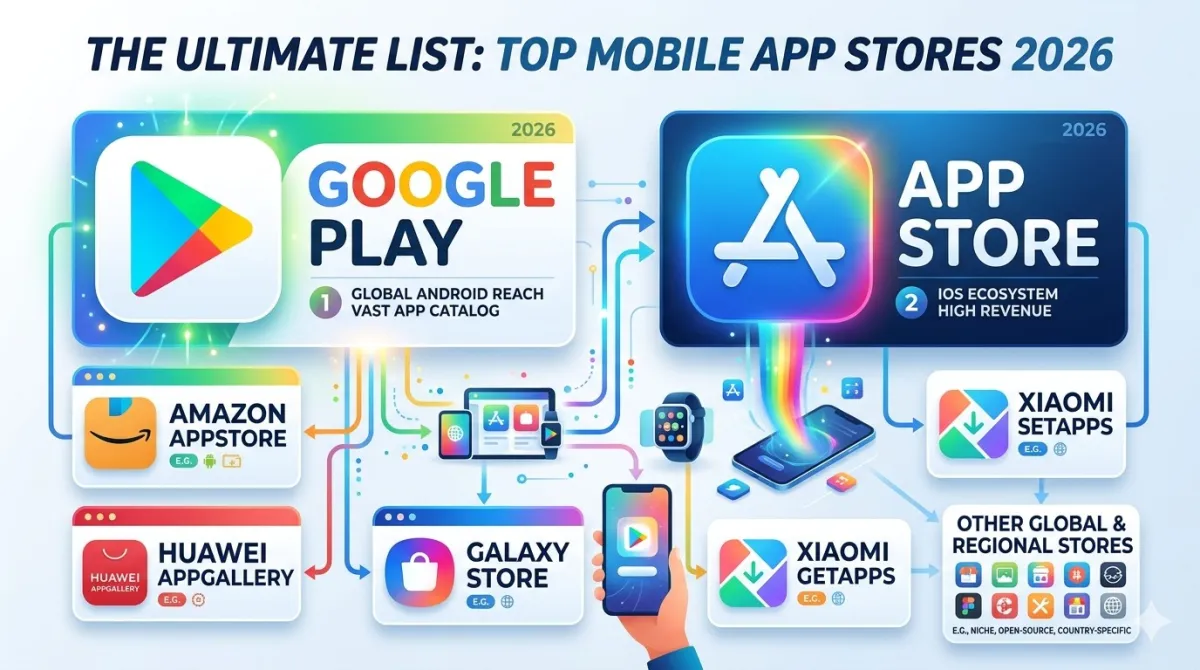
The Top Mobile App Stores:
The Ultimate List in 2026
300 billion app downloads a year, and most developers only use two stores. That's a lot of users left on the table. Let's fix that.
The App Store Landscape in 2026 — What's Changed
The old world was simple: publish on Apple, publish on Google, done. That world is gone — and honestly, good riddance.
Three big forces have reshaped how apps get distributed:
- Regulatory pressure — The EU's Digital Markets Act forced Apple to allow rival iOS stores. The US followed after a DOJ settlement. Real competition finally exists on iOS.
- Fee rebellion — Developers got tired of handing 30% to the duopoly. Stores offering 85/15 or even 88/12 splits are winning real developer loyalty.
- Market fragmentation — Hundreds of millions of users in China, India, and the Middle East don't primarily use Google Play. If your app isn't where they look, it simply doesn't exist for them.
📊 Android vs iOS Market Share by Region (2026 estimate)
The Big Two — Still Your Starting Point
Yes, they take 30%. Yes, there are better deals out there. But with over a billion active iPhone users on Apple and Android powering most of the globe, you simply cannot skip these two.
🍎 Apple App Store
- Users: 1B+ iPhone users; highest spending per user of any store
- Revenue split: 70/30 standard; drops to 85/15 after a subscriber's first year; also 85/15 if you earn under $1M/year
- Cost: $99/year developer account
- Review time: 24–48 hours
- New in 2026: AI-powered discovery and visionOS spatial apps as a new high-value category
- Best for: Premium apps, subscriptions, finance, health, productivity, high-spending mobile games
🤖 Google Play Store
- Users: Biggest global reach; dominant in South/Southeast Asia, Latin America, Africa
- Revenue split: 70/30 standard; 85/15 after 12 months of a subscription; just 15% on your first $1M in revenue
- Cost: $25 one-time fee (yes, forever)
- Review time: A few hours to 3 days
- New in 2026: AI-powered malware scanning and Android 16 format requirements
- Best for: Ad-supported/freemium apps, volume-driven growth, emerging markets
Apple vs Google Play — Quick Comparison
| Factor | Apple App Store | Google Play |
|---|---|---|
| Account cost | $99 / year | $25 one-time |
| Revenue split | 70/30 (85/15 small devs) | 70/30 (15% on first $1M) |
| Review time | 24–48 hours | Hours–3 days |
| Average user spend | Higher ARPU | Higher volume |
| Best market | US, Europe, premium users | Global, emerging markets |
| Build format | .ipa | .aab |
Alternative Android App Stores — The Full List
Here's the thing nobody tells junior developers: there are hundreds of millions of Android users who barely touch Google Play. They use their phone's built-in store, or one specific to their country. If you're not there, you're invisible to them.
Why bother with alternative Android stores?
- Better revenue splits (85/15 or even 90/10 at some stores)
- Far less competition — easier to hit the top charts
- Entire regions where Google Play isn't the default (especially China)
Samsung Galaxy Store
Pre-installed on every Galaxy device. Essential for foldables, Galaxy Watch and DeX apps.
70/30 · Free accountAmazon Appstore
Powers Fire tablets, Fire TV and Windows Subsystem for Android. "Free App of the Day" promos = visibility spikes.
70/30 · No Google APIsHuawei AppGallery
580M+ registered users across China, Europe and the Middle East. The biggest missed opportunity for Western devs.
85/15 · HMS Core requiredXiaomi GetApps
500M+ HyperOS users. Dominant in India and Southeast Asia. Huge for gaming and utility apps.
Free to listOPPO App Market
400M+ ColorOS users (includes OnePlus). Strong in Asia-Pacific and growing in Europe.
Free to listVivo V-Appstore
Essential for reaching tier-2 and tier-3 Indian cities. 100M+ users who are often ignored by Western developers.
Free to listAptoide
300M+ users, 200+ countries. A "store of stores" — brands can create their own sub-store. Popular for Web3 apps.
70/30 · No exclusivityF-Droid
Free and open-source apps only. No revenue split because it only hosts free apps. A community channel, not a commercial one.
Free · FOSS only🇨🇳 China — Its Own Ecosystem
China doesn't just have a different app store. It has a completely different internet. Google Play is blocked, so every major phone maker and platform runs its own store. To reach Chinese users, you'll need at least one of these:
| Store | MAU | Best For |
|---|---|---|
| Tencent MyApp (应用宝) | 400M+ | Gaming — Tencent's gaming dominance makes this a must |
| Baidu Mobile Assistant | 300M+ | Unique Baidu Search integration for discoverability |
| 360 Mobile Assistant | 200M+ | Utility apps — security-trust brand resonates here |
| Wandoujia (Alibaba) | 100M+ | E-commerce and shopping apps |
Third-Party iOS Stores — The 2026 Breakthrough
For years, the App Store was the only way onto an iPhone. That changed. The EU's Digital Markets Act cracked the door open, and a US DOJ settlement pushed it wider. Alternative iOS stores are no longer a weird workaround — they're officially supported.
Apple's notarization process still applies (a basic safety check), so these aren't completely ungated. But the options are real, and the splits are significantly better.
Epic Games Store (Mobile)
Available iOS (EU + US) and Android. 88/12 split — the most developer-friendly major store on the planet.
88/12 · Cross-platform perksSetapp Mobile
Subscription model (€9.99/mo). You get paid by usage minutes, not per download. High quality bar — application required.
Usage-based pay · CuratedAltStore
Developer-first. Home of apps Apple would never approve (hello, Delta emulator). Zero revenue cut.
0% cut · Power usersMicrosoft Mobile Store
Targets cloud gaming and cross-platform productivity. Xbox Game Pass integration reduces user acquisition costs.
Enterprise + gamingEnterprise & B2B App Distribution
If your app is for employees — internal tools, company dashboards, field service apps — it doesn't belong in a public store at all. Putting a private business app on the App Store is a bit like putting your company's internal memo on a billboard. Public stores are for public apps.
Use Mobile Device Management (MDM) instead:
- Apple Business Manager — Distribute privately to managed Apple devices; no public App Store listing needed
- Google Play Managed (Android Enterprise) — Push apps silently to company Android devices
- Microsoft Intune Company Portal — Best for Microsoft 365 environments
- VMware Workspace ONE — Enterprise-grade, handles HIPAA/SOC 2 compliance requirements
Regional Spotlight Stores
🇰🇷 ONE Store — South Korea
A joint venture between SK Telecom, KT, and LG U+. Over 30 million Korean users. An 80/20 revenue split makes it genuinely attractive. If you're building for K-pop, webtoons, or Korean gaming — this is not optional.
🇮🇷 Café Bazaar & Myket — Iran
Sanctions block Google Play for tens of millions of Farsi-speaking users. Café Bazaar and Myket fill that gap, serving 45M+ users who accept local payment methods. A completely overlooked market for Farsi-language apps.
How to Choose — A Simple Framework
Match your app to a store strategy
| App Type | Start Here | Add Next |
|---|---|---|
| Premium / subscription | Apple App Store, Setapp | Samsung, Epic |
| Ad-supported / freemium | Google Play, Amazon | Samsung, Xiaomi |
| Mobile gaming | Google Play, Epic Mobile | Samsung, ONE Store |
| China market | Huawei, Tencent, Baidu | 360, Wandoujia |
| Open-source tools | F-Droid, Aptoide | — |
| Enterprise / B2B | Apple Business Manager, Intune | Workspace ONE |
| Web3 / crypto | Aptoide | — |
| India-first | Google Play, Xiaomi, Vivo | OPPO, Amazon |
| Korea-first | ONE Store, Samsung | Google Play |
Phased Rollout — Don't Launch Everywhere at Once
Trying to be on 10 stores from day one is a great way to burn out and ship buggy updates everywhere. Do it in phases:
Apple App Store + Google Play
Validate your app, collect real reviews, fix the obvious bugs. Don't skip this step.
Samsung Galaxy Store + Amazon Appstore
Low technical lift, big reach. These two alone add tens of millions of potential users.
Huawei AppGallery + Regional Stores
Check your analytics first — if you're seeing traffic from China, Europe on Huawei devices, or India, expand here.
Niche Stores
Epic for games, Setapp for productivity, ONE Store for Korea. Go niche once you know it fits your category.
💰 Developer Revenue Split by Store (% developer keeps)
Common Mistakes to Avoid
- Publishing on only 2 stores — You're leaving China, India, and Korea almost entirely untouched.
- Using the same APK for all stores — Huawei needs HMS Core; Amazon needs GMS-free builds. One build doesn't fit all.
- Copy-pasting store metadata everywhere — Each store's search algorithm works differently. Localize your titles and descriptions.
- Ignoring Chinese compliance — ICP license and MIIT registration are mandatory, not optional. Skipping them means instant rejection.
- Expanding to 10 stores without automation — Manually managing updates across 10 stores will collapse under its own weight. Set up Fastlane first.
- Three strikes on Google Play — Policy violations can result in a permanent account ban, not just app removal. Read the policies.
- Treating launch as the finish line — ASO, update cadence, and responding to reviews all affect long-term rankings. The work doesn't stop at launch.
FAQs
Ready to Distribute Smarter?
The "two-store era" is over. Here are your three next steps:
- 📊 Pull your analytics — find out where your users actually are
- 🗺️ Use the table above — pick your top 3 expansion targets
- ⚙️ Set up Fastlane — automate before you expand, not after